

NEWS
Conservation of the Covered Market continues

46-48 Covered Market, Oxford
Following a period of downtime, Croft Building and Conservation re-commenced work on 46-48 Covered Market on the 1st June 2020. Following the first week of re-establishing site, setting up hand sanitising stations and agreeing method statements, the site was fully operational the following week. The starting of site work preceded the general opening of the Covered Market and as a result we reviewed the programme ahead and agreed to advance certain aspects of the project to ensure that social distancing could be maintained when the market re-opened on the 15th June.
The modern brick and glazed screen had been intended to be removed as part of a final finale once the works were complete – however to comply with the City Council’s method statements and social distancing rules, we agreed that the screen should be removed so that stall owners and visitors could see the work more freely without stopping to see it. This would have the added advantage of reducing restrictions on the width of the avenues improving flow around the market.
The early revealing of the restoration project has prompted several complimentary comments from other stall holders. The restored units are attracting much interest from prospective new tenants, which is a credit to Oxford City Council and Oxford Preservation Trust’s commitment to funding the conservation of the Covered Market
Back to basics - Bere Farm

Bere Farm, Warnford
We are delighted that planning and listed building consent has been granted for alterations to one of the oldest farmhouse in Hampshire: Bere Farm, Warnford. The proposals involve restoring the character of the interior whilst unpicking crude and damaging late 20th century alterations to early fabric. A detailed heritage and design statement was prepared to illustrate where changes where being made and the age of the fabric affected.
Plans include, restoring the linear arrangement of the principal rooms served by the 18th century corridor to the north of the house and reinstating the medieval hall at the centre of the house. Contemporary alterations involve; a large kitchen to the west of the house and a new master bedroom suite at first floor with uninterrupted views out along the lane.
Bere Farmhouse is an ancient house dating back to 1528. It is unusual as it is a very early floored-hall building - i.e. the hall was never two storeys and timber chimney stacks carried smoke from the hall. Sixteenth century service quarters were replaced in the early seventeenth century. A catslide roof was added to the rear in the 18th century and at the same time the whole house refaced in brick to follow architectural fashion. A Victorian range was added to the east at the end of the 19th century replacing an earlier parlour. The house was sold on the open market in 1978 and since then a number of damaging changes have adversely affected the character of the farmhouse.
Church Farm Annex - Approved.

Despite a short delay to the application process as a result of COVID-19 we are pleased to have received planning permission for a new annex at Church Farm House, North Moreton. We have made the most of the planning period to resolve all of the planning conditions and the building control issues so work can start immediately.
Church Farm House is Grade II listed and within the North Moreton Conservation Area. The new annex is set within the old farm yard, and is surrounded by a number of old farm buildings such as the Granary, Boiler House and Cart Shed which remain curtilage listed. Set between the stables to the west and the garden to the east the design of the new annex responds to the changing characteristics of the site and immediate setting. The west elevation has therefore been designed to look agricultural, whilst the east elevation is designed to look domestic. Careful massing studies were carried out from the outset to ensure that the new annex did not dominate the curtilage listed buildings and their roof lines – particularly the old Granary.

The annex integrates storage for stables and a tack room, with independent residential and agricultural access. The annex will provide accommodation for three with limited reception accommodation.

The permission marks phase I of the proposals for a new family annex. The annex is designed for members of our client’s family to visit over major festive periods such as Easter and Christmas and will be lived in by the applicants whilst work to the main house is being carried out.

COVID-19 Update

Following the Prime Minister’s announcement on Monday 23rd March, we have implemented new working processes so that we continue to be fully operational, whilst doing our upmost to protect our staff, clients and other local businesses.
Where possible our staff are now working from home, whilst the office remains open for those who are unable to do so.
We are strictly following government guidance on social distancing to mitigate the spread of COVID-19 and have made changes to our office environment so that the 2m distancing rules are maintained to protect the safety and wellbeing of our staff and other local businesses.
We are now carrying out all possible meetings through video conferencing technology which allows us to screen share our drawings and presentations.
We are risk assessing site visits and inspections on a case by case basis and will continue visits only where it is possible to follow 2m distancing rules, where meetings involve no more than 2 people on site and with access to regular hand-washing facilities. Where this is not possible, we are exploring video conferencing and improved communication using existing mobile technology, the use of filming and photography.
We will keep you updated on our approach to the situation and how we are maintaining our professional service levels. If you have any queries regarding your project please do contact James directly.
Mission church - a faithful approach to design
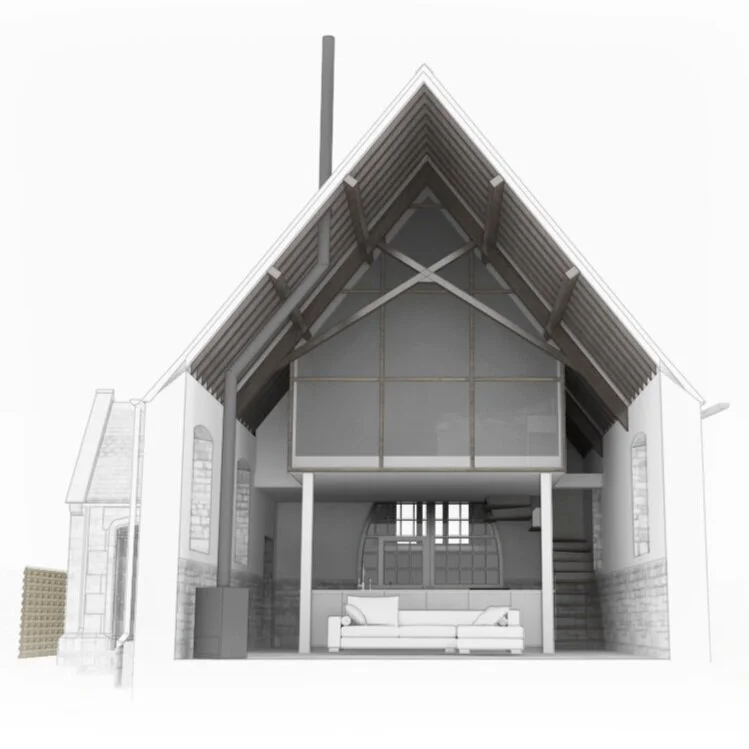
We are pleased to announce that we have received planning permission for the conversion of Mission Church, Paxford into a two-bedroom, holiday let.
‘Mission Church’ was initially constructed as an Infant School for 100, in an ecclesiastical style and was used for Church services very shortly after. In 1886, the building became a National School, spreading the Mission of the Church and promoting education to the poor.
The design retains a significant part of the Nave and the view of the Chancel from the entrance. New bedroom accommodation is provided in a mezzanine pod toward the west end of the Nave and in the old classroom. Existing features such as the exposed rafters, the classroom door, stained glasses, polychrome panels and graffitied plaster are to be retained and conserved.
The design incorporates the latest in technological innovations. Retaining the open plan arrangement with a kitchen between the main living spaces and the only fire exit was the primary design challenge. The solution has been to install an Automist smart scan system, a system which provides an alternative solution to a traditional sprinkler system. The cost of the system is £5000 ex VAT and is cost neutral in contrast with the comparable work of installing new partitions and fire doors.
Patience (and good design) prevails

Tonight, thanks to councillors, Wardington Parish Council and a wealth of public support, we received planning and listed building consent for alterations and the extension of Lower Lodge, Williamscot.
Our clients have a young family and wish to extend the lower lodge, sympathetically, whilst removing incongruous previous extensions to make this 2 bedroom house a 3 bedroom family home with an ensuite bathroom, to make this their forever home in the idyllic village of Williamscot.
The project is unusual as it involves a curtilage listed building, extended poorly in the 1960s and 1980s yet the planning officers refused to recognise that good sensitive design was an important part of conservation, insisting that the ugly flat roof extensions must remain.
English Heritage’s conservation principles dated 2008 confirms that new work or alteration to a significant place should normally be acceptable if the proposal would not materially harm the values of the place, which, where appropriate, would be reinforced or further revealed; and the proposals aspire to a quality of design and execution which may be valued now and in the future.
Six previous attempts to secure consent by other local architects have failed. Our unique design approach was approved this evening at a planning committee.
Manor House, Islip - from farmhouse to home

We are delighted to have received planning and listed building consent for alterations to Manor House, Islip. In a bold, but sensitive scheme, consent has been granted to convert the old farmhouse into a contemporary home. The proposals involve providing additional dormers in the roof space so that the attic can be converted for bedroom accommodation. At first floor, the removal of modern partitions will create a generous master bedroom suite. On the ground floor, later partitions will be removed to restore the symmetry of the central sitting room and adjust the bay window so that the utility can be used as a breakfast room. The construction of a new garden room to the rear will provide aspect out onto the garden.
The proposals also include a scheme of repair including the re-roofing of the stone slate roof, re-pointing and unpicking of unsightly alterations to the rear.
Our initial research has established that the dwelling was once a farmhouse dating from the early 18th century. Despite its historic and architectural importance the house has seen many changes, particularly in the 19th century when the house was updated to Victorian standards with a dedicated coal house, wash house and separate kitchen. Victorian windows were added in the ground floor and the east end adapted in the 19th century, and long used as the village store. The proposals will remove poor 20th century alterations restoring the dignity of one of the oldest working houses in Islip.
Bere Farm - Back to Basics

Bere Farmhouse
It takes a confident client to take on the challenges of restoring a Grade II listed farmhouse - returning the interior to within some semblance of its historic past. We are delighted to have been engaged to help restore one of Hampshire’s oldest farmhouses.
Bere Farmhouse is an ancient house dating back to 1528. It is unusual as it is a very early floored-hall building - i.e. the hall was never two storeys and timber chimney stacks carried smoke from the hall. Sixteenth century services quarters were replaced in the early seventeenth century. A catslide roof was added to the rear in the 18th century and at the same time the whole house refaced in brick to follow architectural fashion. A Victorian range was added to the east at the end of the 19th century replacing an earlier parlour and the front of the house clad in tiles. The house was sold on the open market in 1978 and since then a number of damaging changes have adversely affected the character of the farmhouse.
Our clients plans include restoring the character of the interior whilst unpicking crude and damaging late 20th century alterations. Plans include, restoring the linear arrangement of the principal rooms served by the 18th century corridor to the north of the house. As a consequence, a new kitchen is required to the west of the house - the only location for a new kitchen with views out onto the garden. At first floor the 19th century extension is the best location for the master bedroom with uninterrupted views out along the lane.
Mission Church, Paxford - A faithful approach to design

Mission Church, Paxford, view from east
We are delighted to be commissioned to develop designs to convert Mission Church into a two bedroom, holiday let. The design and alterations have been informed by a heritage statement and condition survey which we undertook earlier this year.
The project is unusual as Cotswold Council have determined that the building is a non-designated heritage asset under the NPPF and so sensitively converting the interior is a material consideration. Whilst non-designated heritage assets do not fall under the listed building act of 1991, the design of the interior has to be made to respect the heritage of the Church and as a result building regulations matters have to be taken into consideration at an early stage.
‘Mission Church’ was initially constructed as an Infant School for 100, but was designed in an ecclesiastical style and indeed was used for Church services very shortly after. In 1886, the building became a national school, spreading the Mission of the Church and promoting education to the poor.
Listed and leaking roof resolved through carefully considered design
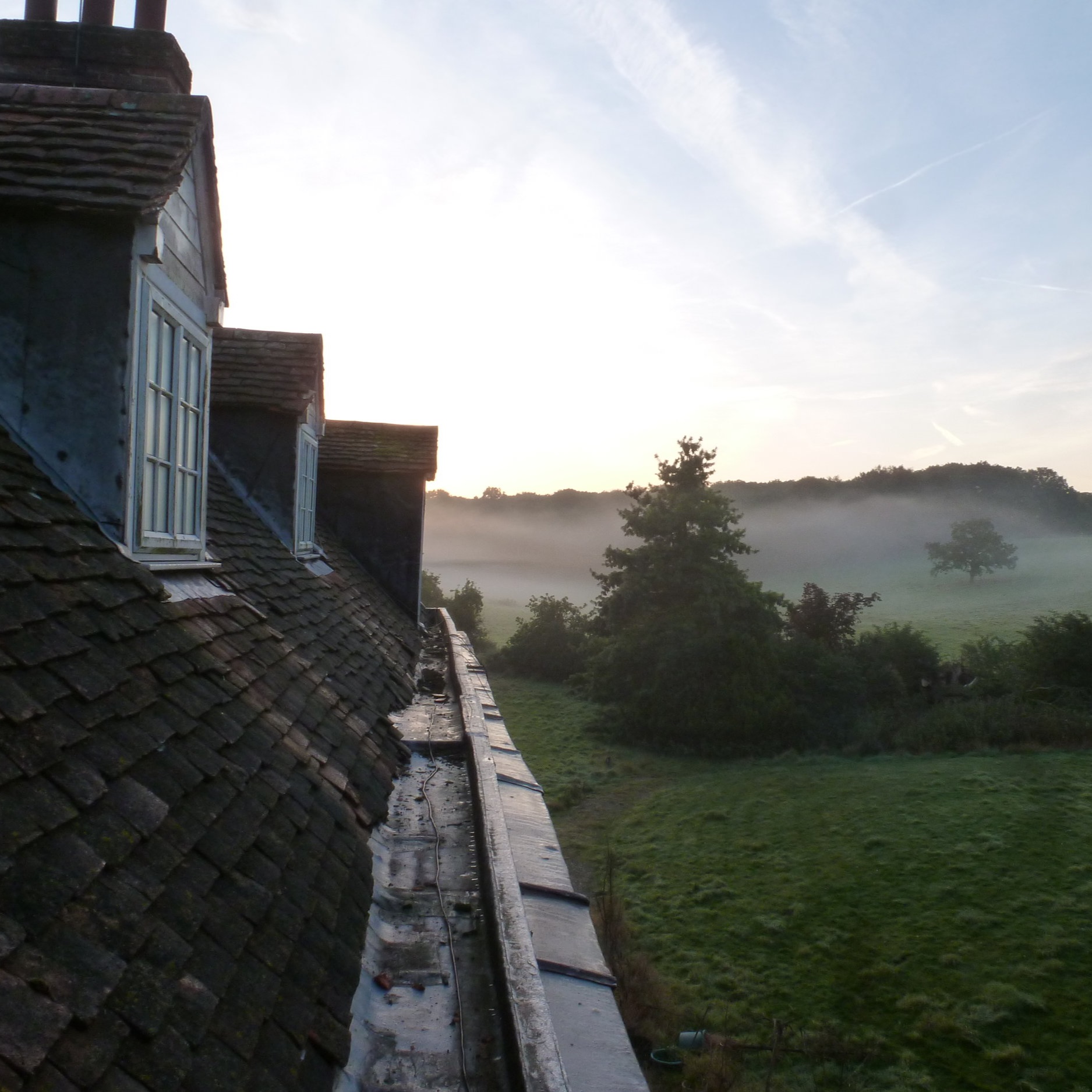
Bere Court - parapet gutters
We are delighted to have received listed building consent for the re-roofing of Bere Court. The repair work will make the external building fabric watertight, allowing the interior to dry out after 40 years of neglect, and allowing this beautiful historic house to be used once more as a family home. The process involved a conservation-based options appraisal to inform dialogue and discussion with Historic England, to achieve a sensible and affordable scheme.
Our conservation-based feasibility study, identified options and the impact of replacement of the parapet gutters and the internal lead flat roof. The feasibility study confirmed that the cost of replacing the internal roof was unaffordable. The heritage statement confirmed that the roof structure was historically problematic and that the current late 19th C arrangement was made to resolve previous defects in the design, and as a result of recent global warming the late 19th C design is no longer fit for purpose.
The new design has twice the number of outlets with catch pits. By increasing the bore size of the outlets we have substantially improved discharge capacity, so that the gutters and downpipes have additional capacity for a future increase in rainwater of 35%.

19 - New down pipes replacing earlier pipes.
1, 3 and 23 - Cornice repairs, new weathering, and parapet