

NEWS
Mission Church, Paxford - A faithful approach to design

Mission Church, Paxford, view from east
We are delighted to be commissioned to develop designs to convert Mission Church into a two bedroom, holiday let. The design and alterations have been informed by a heritage statement and condition survey which we undertook earlier this year.
The project is unusual as Cotswold Council have determined that the building is a non-designated heritage asset under the NPPF and so sensitively converting the interior is a material consideration. Whilst non-designated heritage assets do not fall under the listed building act of 1991, the design of the interior has to be made to respect the heritage of the Church and as a result building regulations matters have to be taken into consideration at an early stage.
‘Mission Church’ was initially constructed as an Infant School for 100, but was designed in an ecclesiastical style and indeed was used for Church services very shortly after. In 1886, the building became a national school, spreading the Mission of the Church and promoting education to the poor.
Listed and leaking roof resolved through carefully considered design
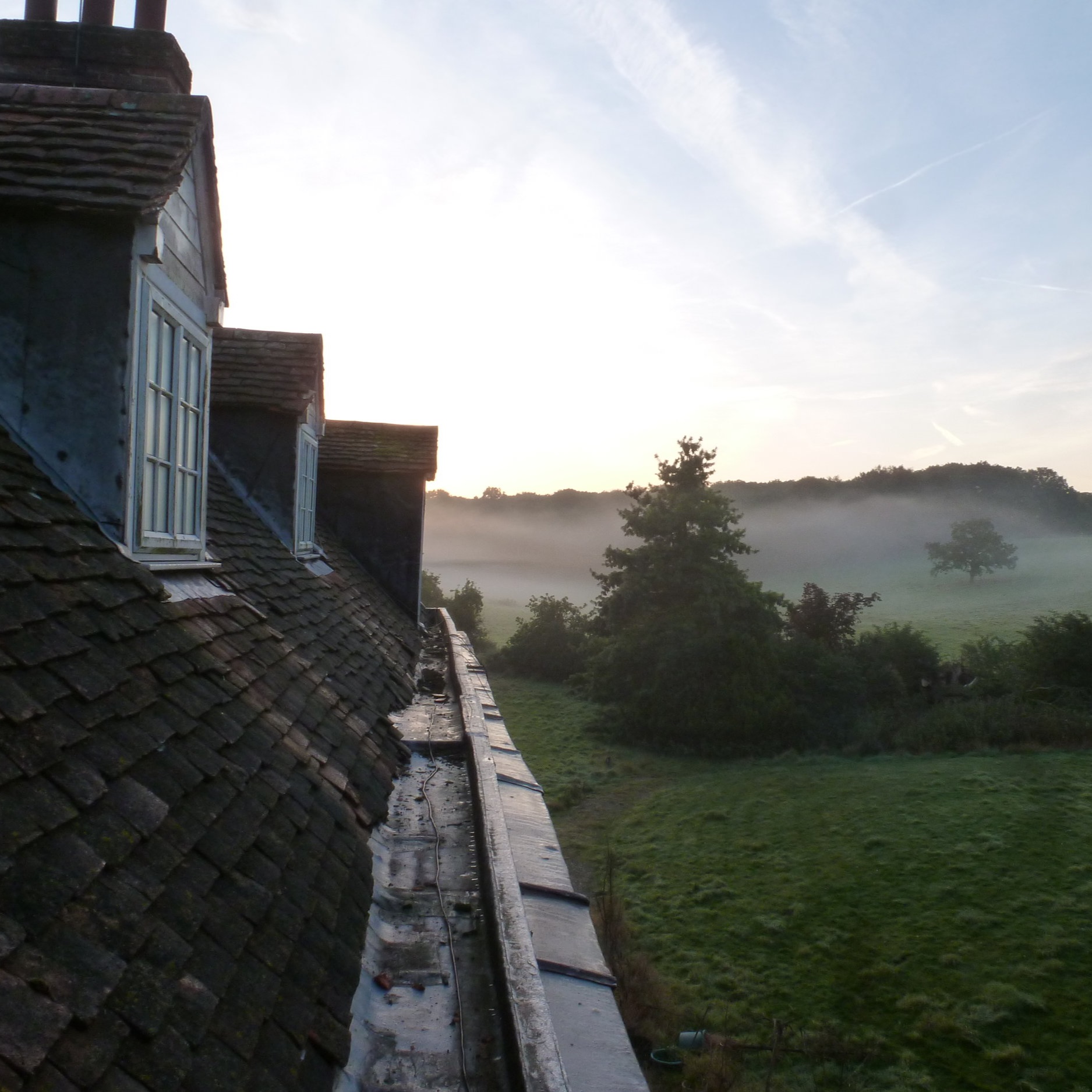
Bere Court - parapet gutters
We are delighted to have received listed building consent for the re-roofing of Bere Court. The repair work will make the external building fabric watertight, allowing the interior to dry out after 40 years of neglect, and allowing this beautiful historic house to be used once more as a family home. The process involved a conservation-based options appraisal to inform dialogue and discussion with Historic England, to achieve a sensible and affordable scheme.
Our conservation-based feasibility study, identified options and the impact of replacement of the parapet gutters and the internal lead flat roof. The feasibility study confirmed that the cost of replacing the internal roof was unaffordable. The heritage statement confirmed that the roof structure was historically problematic and that the current late 19th C arrangement was made to resolve previous defects in the design, and as a result of recent global warming the late 19th C design is no longer fit for purpose.
The new design has twice the number of outlets with catch pits. By increasing the bore size of the outlets we have substantially improved discharge capacity, so that the gutters and downpipes have additional capacity for a future increase in rainwater of 35%.

19 - New down pipes replacing earlier pipes.
1, 3 and 23 - Cornice repairs, new weathering, and parapet
46-48 Covered Market – uncovered.

View along avenue 2
As a first phase of a heritage led regeneration of the Oxford Covered Market, planning permission and listed building consent was granted for the restoration of 46-48 Covered Market. The scheme restores the unit, externally removing modern brick extensions to improve views along the avenues, whilst internally uncovering and repairing early fabric. Alterations will provide a flexible layout for up to three smaller units, which is proving very attractive for best in class independent retailers. Davis Witts of Pershore Foods has opened a new fishmongers in the former Hayman’s unit and the Teardrop micropub has opened a new food emporium in the unit next to the bar selling local produce.
We first realised that the stall was too good to leave covered up following a survey in April 2018. However, careless alterations carried out prior to the Market being listed in March 2000, meant that there was a large funding gap to repair the store properly. Oxford Preservation Trust have funded the conservation work which has allowed Oxford City Council to restore the units sympathetically.
Opening up work carried out in June 2019 by Oxford Direct Services has begun to reveal more about the original fabric and history of the units. The original stone flag floor and surviving sections of chimney breasts which form part of the 18th Century phase. Remnants of the early shop front frames have been revealed and have allowed us to redesign the new shop fronts in a more fitting design closer to the earlier appearance. Wall-tile paintings by artist John Ellis a gift to butcher, Mr Feller, have been saved and will be presented elsewhere in the market. The project goes out to tender this week to a number of local contractors and works are due to start at the end of August 2019.
Manor House, Islip, Oxfordshire

We are very excited to have been instructed to help our clients with this Grade II listed house in Islip. Our brief to explore design options and understand the level of development likely to be possible. The house is one of the oldest in the village and has a number of practical issues for modern living: Firstly, the Victorian layout creates a series of interconnecting inner rooms accessed from one another. Secondly, as a working house - it misses a large kitchen with aspect onto the garden.
Our initial research has established that the dwelling is one of the oldest working houses in Islip dating from the early 18th century, the main period of growth in Islip’s development, a bustling village with 8 inns, serving carriages between London and Worcester and local traffic from Bicester to Oxford. Manor House acts as Mill Street landmark - a fabulous example of classical architecture responding to the local vernacular. Despite its historic and architectural importance the house has seen many changes, particularly in the 19th century when the house was updated to Victorian standards with a dedicated coal house, wash house and separate kitchen. Victorian windows were added in the ground floor and the east end adapted in the 19th century, and long used as the village store. Sadly 20th century alterations have not been kind to the house and provide opportunity to make improvements.
Cassington Memorial - Conserved with dignity and care

Repairs are now complete to Cassington Memorial – a project commissioned by Cassington Parish Council as the uniqueness of the memorial is something that the Village is very proud of. The project was funded by Cassington Parish Council with grant funding from the War Memorial Trust. The stone repairs were executed with great sensitivity by specialist stone mason Trevor Dean of Banbury.

Before

After
The memorial pays tribute to those that died in the first and second world wars and was constructed by Mr FD Howard and Mr Alec Miller of Axtell and Son. The statuary depicts life and death and the plinth bears inscriptions: To the gallant dead. Death is swallowed up in victory. Cassington Parish Council have maintained the memorial in excellent condition for the past 70 years as a loving memory to those who lost their life in the war.

Chipping Norton, High St - High-end apartments.

We are delighted to have secured listed building consent for alterations to Grade II* listed No. 20 High Street, Chipping Norton, to provide staff facilities at ground floor and convert first and second floors into two high end apartments.
The proposal involves the conversion of the redundant first and second floor into a high end residential apartments retaining and revealing historic features, improving on a previous scheme dated 2016. The scheme provides an additional 8.5qm of floor space within the attic - enough to make the floors lettable as two separate apartments. The scheme was resolved collaboratively through consultation with the Local Authority, Historic England and our client Jeremy Catling which was the key in gaining consent. These alterations now pave the way for letting the ground floor unit as a priority, and future plans at first and second floor which will help fund repairs required.
The building dates back to 1390 when it was most likely a merchants house with an undercroft below. Whilst the undercroft remains in the basement most of the building fabric from ground to second floor is 18th Century. In the 18th Century the building was a Butchers Shop before becoming the Bear Inn in 1797. For a very short period between 1915 to 1931 the first floor was used as a surgery. However, since the mid-19th Century the ground floor has always been used as a shop.
Packwood Piers

Following a lovely spring day surveying at Packwood House, Warwickshire, we are delighted to have been appointed by the National Trust to carry out the rebuilding of the piers on the main entrance driveway.
Our survey revealed that the piers are leaning from the brick footing at ground level, so all of the brickwork will need to be carefully dismantled, recorded and re-built from the base up. The pier is of no immediate safety concern but will be rebuilt this year as a precaution. We are busy drawing up each and every brick so that the piers can be rebuilt. The conservation conundrum is whether to rebuild the piers exactly as they were originally - other piers across the site have finials and those on the south piers appear to be missing. The origin of these piers is as yet unclear.
Packwood House belonged to the Fetherson Family from the 15th to the 19th Centuries. Charles Fetherson (1815) insisted everything he ate drank, used and wore be grown on his land and made within his walls. Sadly this did not last and the house fell to ruin. Packwood was eventually bought by a midlands industrialist, Alfred Ash in 1905. His son Baron Ash made its restoration his life’s work. The entire interior was inserted in the 1920-1930s garnered from decaying houses across Britain. Baron Ash was of a generation that disliked Georgian and Victorian styles, his aesthetic preference was for the antique.
1m and 58 seconds of fame at the Elizabethan House - investigations

A little old now, but I have just seen this on-line and thought I would share my first 2 minutes of fame from last year… Dan Cruickshank - your job is safe for now!

Parquet - no way!

Works to remove the 19th Century Wood Veneer Floor from the Drawing Room at Bere Court and replace it with a periodically sensitively designed new oak floor was unanimously approved by planning committee Councillors on Wednesday evening. The works were called to committee owing to previous resident’s claims that the floor was a very early 18th Century parquet floor.
The removal of the floor is required to remove extensive areas of asbestos that were identified in an asbestos survey report carried out in 2017. Our investigations with Japser Weldon, May 2018 confirmed that the floor was a wood veneer floor adhered to a timber substrate and the floor joists below the floor were 19th Century. Our thorough investigations and sensitive proposals were supported by Historic England and West Berkshire Council’s conservation officer.
The consent will enable a major phase of asbestos removal planned later in February. The asbestos removal will make Bere Court safe for our client, their children and grandchildren to live in for many years to come.
Lions lucky escape

James Mackintosh Architects have been appointed to carry out the reinstatement of the north front balustrade stonework to the west of the Porte Cochere at Stowe House. Damage was caused following an accident, involving one of the house security guards who suffered heart attack whilst driving and crashed at speed. The incident came as quite a shock, but fortunately the security guard is recovering following surgery. Works on the reinstatement commenced this week.
The project involves the removal and reconstruction of the lion plinths, and the reconstruction of the balustrade stonework, using as much of the surviving stonework as possible. Careful consideration has been provided to the method of lifting the Coade Stone Lions which have high architectural significance. A method statement has been prepared by the Morton Partnership and the execution will be carried out by specialists Cliveden Conservation.
Cliveden Conservation commence repairs on the Lions this week. Cliveden Conservation have been involved in several phases of repair at Stowe, including the relocation of the Bickerdyke Lions from the South Front only a few years ago. Their first priority will be safely relocating the west Coade Stone Lion so the plinth can be rebuilt.