

NEWS
Roof repairs to a Grade I listed Country House
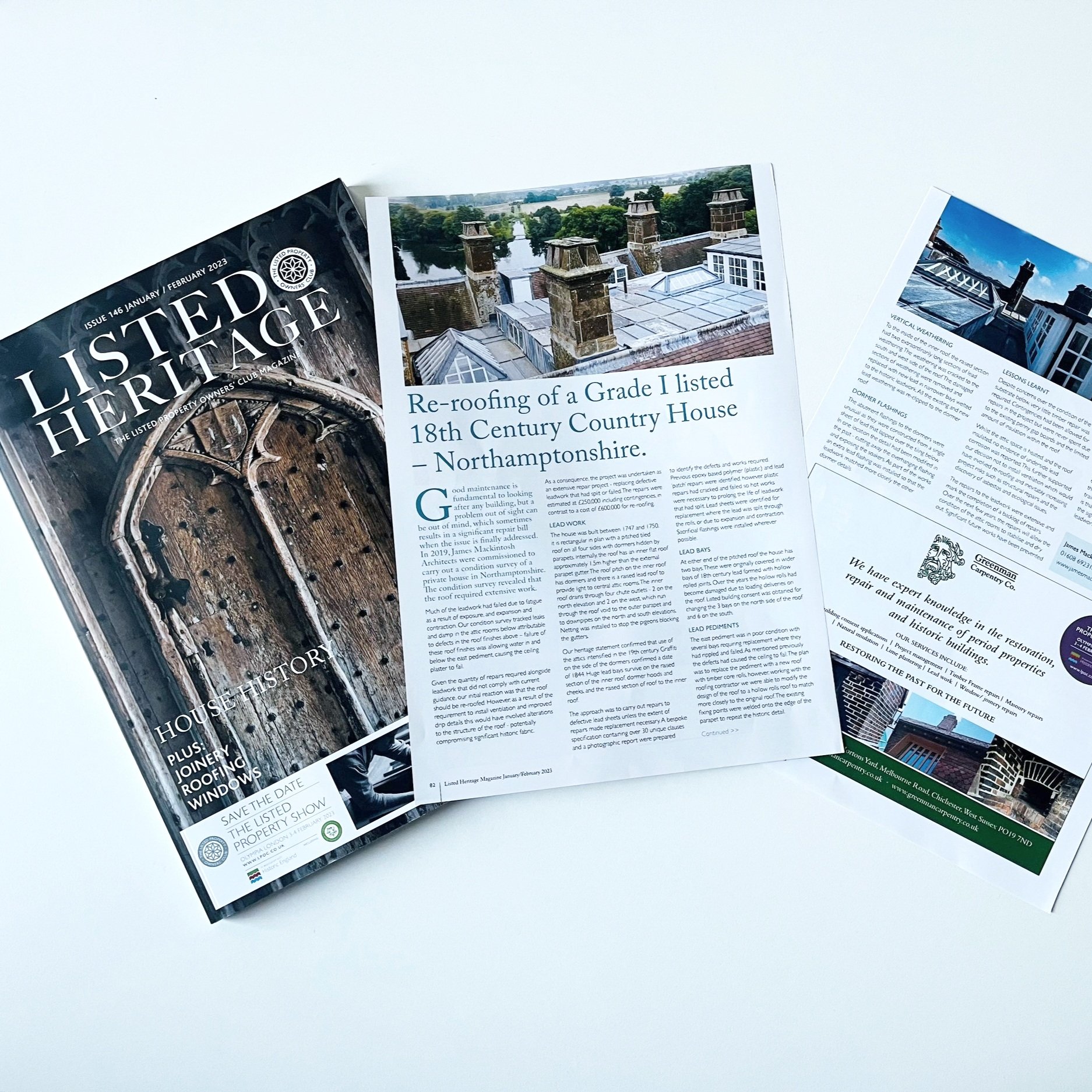
Our recently completed re-roofing of a Grade I listed Country House has been published in the recent Listed Property Owners Club Magazine.
Last year we completed a re-roofing repair of a Grade I listed house in Northampton. The cautious approach to conservation undertaken ensured that significant historic fabric was retained as well as de-risking the project and reducing the anticipated repair bill by two thirds.
46-48 Covered Market wins Oxford Preservation Trust Award

In October this year we were awarded a certificate at the Oxford Preservation Trust awards for our involvement in the restoration of the historic shopfront of 46-48 Covered Market.
As with many of our projects the success of the completed project looks like they have always been there, through preserving and enhancing the structure and historic fabric of the grade II listed market. Despite the size of the units the work involved in their transformation was considerable owing to damage caused to the units prior to their listing in 2000.
Completed - Church Farm House North Moreton
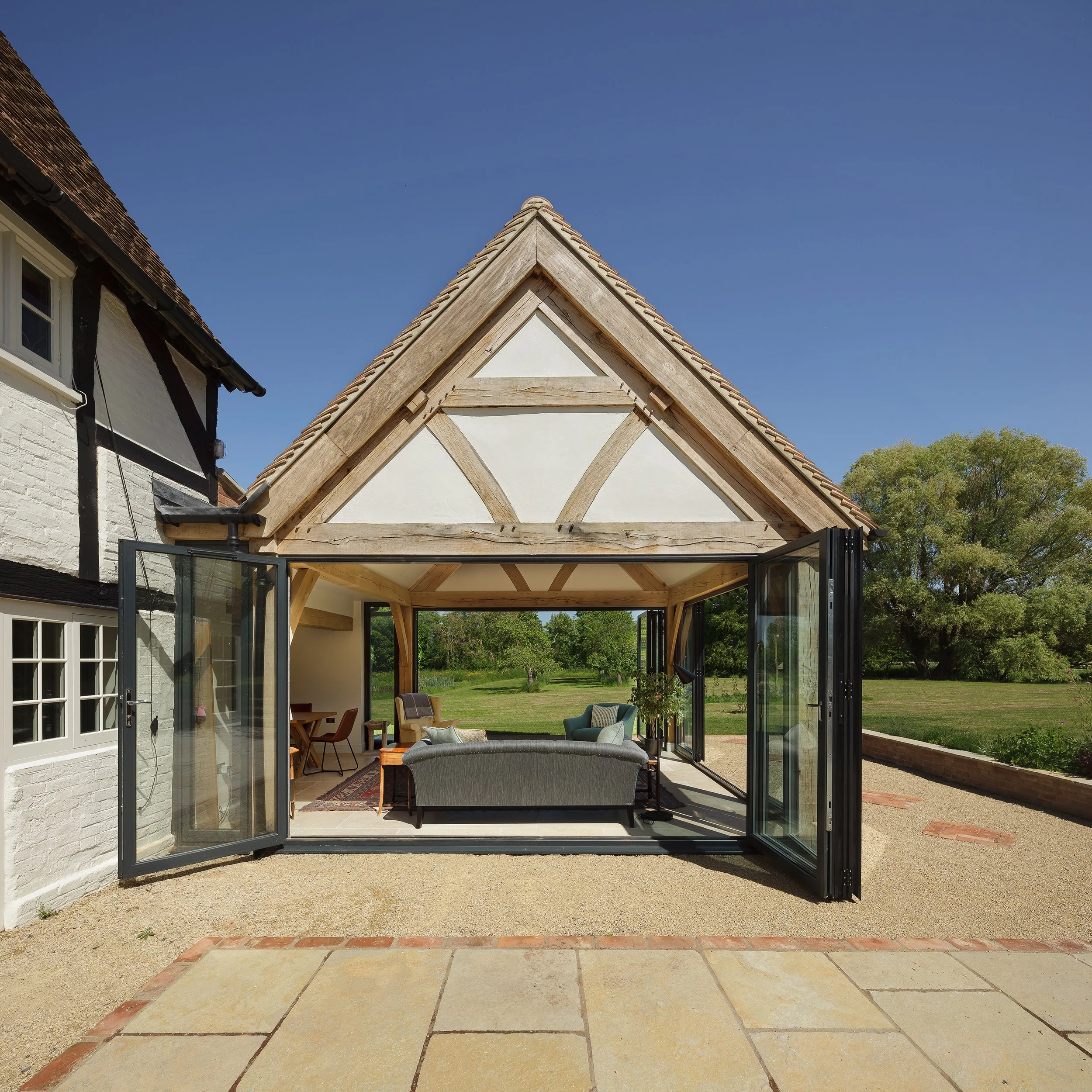
Church Farm House is a generous family home, however, the oldest part of the house is timber framed with very small windows. The interior therefore lacked aspect onto the garden and surrounding countryside. The existing kitchen was too small and lacked a dining area. Having recently moved into the house, our clients wished to modernise and extend the house to contemporary living standards.
In order that the works could be progress as soon as soon as possible, we developed a programme and separated the project into three phases to prioritise planning permission for the Annex, so that this building could be built and occupied whilst work on the house was underway. This allowed time for pre-applications exploring options for extending the listed building.
Planning permission for the annex was granted in early 2020 and the works completed by December 2020. Works on the house started in January 2021 and completed by October 2021.
Completed - The Elizabethan House, New Street, Plymouth
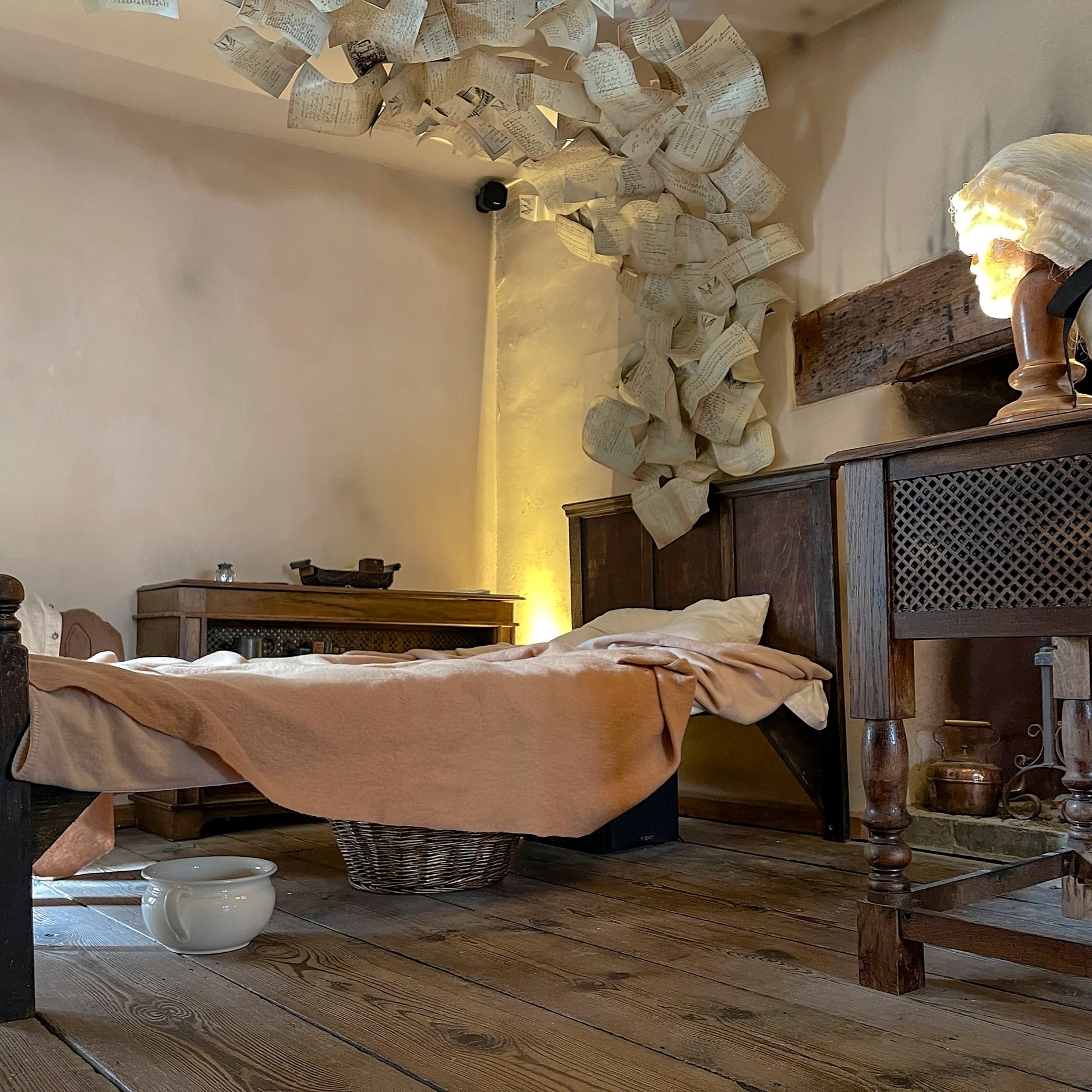
The Elizabethan House reopens as a new immersive museum experience at No.32 New Street the Barbican, animating the story of the house and those that lived there through the eyes and ears of the building from its construction to the saving of the house in 1930s by the SPAB.
The conservation approach was a result of a joint architectural strategy between JMA and DHVA which identified at the briefing stage that an extension would be required to the rear of the property. We identified early on that the exhibition might require a green room and toilets facilities. The new building contained a riser that allowed the distribution of miles of data cable throughout the old house with the minimal impact on historic fabric. It also acted as a buttress to support the failing rear wall.
This allowed the rooms to be presented authentically, as the spaces themselves remain unchanged as the heritage statement and visual analysis confirmed that the physical spaces remained unchanged for 400 years.
Completed - Mission Church - A faithful approach to design

© Simon Maxwell Photography
Following a sensitive adaptive reuse of a Mission Church, clients Geoff and Julie are celebrating a new lease of life for “The Old Mission Church” which is now available to rent as a Cotswolds retreat in the picturesque village of Paxford.
Whilst the Mission Church was not listed, the local authority considered the building a non-designated heritage asset. Cotswold District Council’s planning policy confirms that conversions of all non-domestic historic buildings should conserve the significance of the heritage asset including its form, features, character, and setting. A conservation based approach was adopted for the conversion based on an understanding of the buildings history and significance.
The conservation approach adopted was to repair and reuse the existing fabric whilst adopting a minimal approach to modern interventions through maximising the use of existing spaces and through the installation of a contemporary pod which appears to float in the space, providing a mezzanine level master bedroom and ensuite.
The final finishing touches are credit to the love and dedication that Geoff and Julie have given the project provided reusing items salvaged from church. A lantern purchased with the building has been restored to be the main light in the living room. The pulpit has become a table and a headboard. The Bell chime mechanism has been restored by Paxford Engineering, new door runners fabricated by MRK and the clock face sprayed at Brothertons, all businesses based on the Northwick Park Estate.
The external walls have been cleaned, the building fabric insulated and upgraded and the building now has a new use for the next 150 years to be shared with as many guests as possible, whilst continuing to be a beautiful focal point for the village.
Wendy's technical term of the month - Brick Tax
As a result of the brick tax between 1756 and 1850, the increase in the size of a brick is now useful in helping date the construction of a building.

Pre-1784 bricks in the house on the right versus newer bricks on the left.
The impact of the brick tax on architecture was to see many areas returning to the use of timber and weatherboarding in house construction, especially weather tiles to simulate brick work, known as mathematical tiles. Until 1833 the brick tax also applied to roof tiles and drainage pipes. The taxation of pipes led to a lower quality of housing as many households could not afford drainage pipes due to their increased price. Tiles were taxed based on the size and level of decoration, which made people use plain tiles, which were the cheapest. In general buildings constructed before 1784 and after 1850 show more ornaments, better design and detailing than buildings built within this period.
A Brick Tax was first proposed in 1756. The proposal was initially considered to be only partial since much of Britain used stone for building, and unfair, as the tax would not apply to the rich as their houses were built almost exclusively from stone. It failed to pass but was reintroduced in 1784 to help pay for the War of American Independence by which time bricks had grown in popularity and use. Bricks were initially taxed at 2s 6d per thousand and the word ‘excise’ imprinted on bricks that had been taxed.
To mitigate the effects of the per-thousand brick tax, manufacturers began to increase the size of their bricks (useful now as the size of the bricks can help date the construction of a building) this was eventually held in check by new legislation that specified the size of a single brick. The brick tax was finally abolished in 1850 by which time it was considered to be a detriment to industrial development.
Lower Lodge Williamscott - work in progress

It has been nearly 2 years since planning permission was granted at committee for the extension of Lower Lodge Williamscott; having started work in June 2020 works are well underway.
Our clients are well underway to completing the self-build of the alterations and extension to this curtilage listed lodge at Williamscott, Oxfordshire.
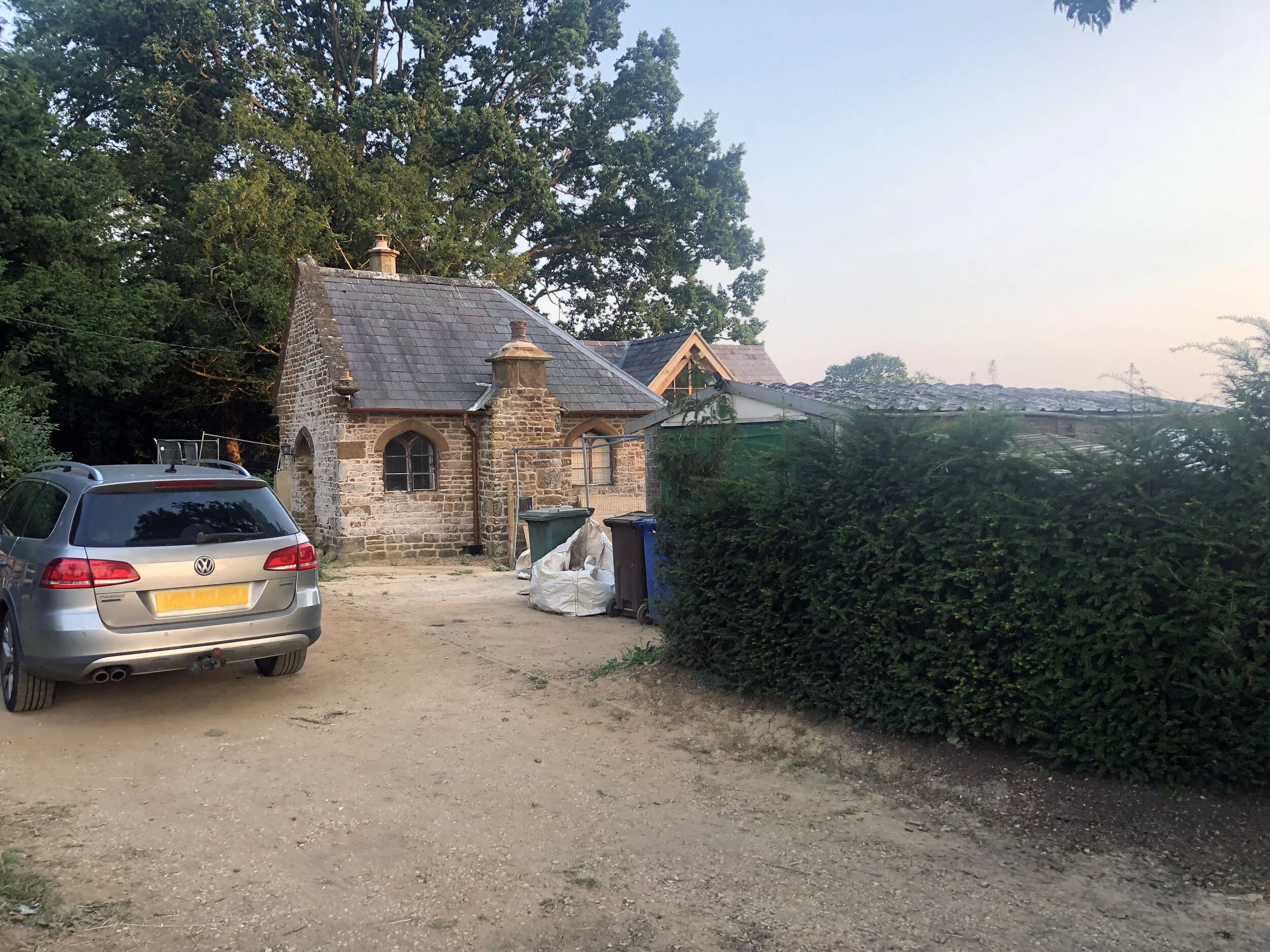
The proposals involved a sympathetic extension to the lower lodge to make the 2-bedroom house a 3-bedroom family home with an ensuite bathroom, so there is ample accommodation to make this a forever home in the idyllic hamlet of Williamscott.

Our proposals involve removing all modern extensions to make way for a new sensitive design. The development is to be located as far as possible from the key views to avoid impact on the conservation area and allow the original form of the lodge to be restored. The topography of the site falls away to the south allowing an additional storey to be created below the current ground floor, creating an additional increase in the footprint of the house by 45 sqm. New accommodation at ground floor includes a contemporary kitchen diner with stunning views to the landscape beyond.

Wendy's technical term of the month - Slobbered Limestone
“When planning to alter a finish we should always take into consideration why the work was done in the first place and specific finishes should be replaced like for like.”

The term ‘slobbered limestone’ seems to be more popularly used in the north of England nevertheless there are many examples on vernacular buildings in exposed areas elsewhere that are prone to wind-driven rain. In such places, buildings of rubblestone have often been rendered, if not fully rendered, then walls were ‘slobbered’, that is pointed with a thickly applied mortar. A high proportion of mortar to limestone rubble was important applied full to the face of the stonework in several coats and limewash then applied. The lime mix used often contained a large aggregate which can look much like modern pebbledash. Along with the limewash applied onto it, slobbered coats stop rain from penetrating stonework, the aggregate forming a large surface area which stops rainwater running down walls and lets it dry out with the help of the wind and the sun.
Over time, mortar coats have often degraded and fallen away, leaving a flush pointed finish exposed that can allow wind driven rain to penetrate the pointed wall beneath and cause problems with damp. Misunderstanding of this method and the fashion for exposing stone means that the pointing is often brushed back too far between the stones to make them visible. Some stonework was never meant to be seen, walls having been built to be rendered or ‘slobbered’ for their weather protective qualities rather than their aesthetic ones.
A perfectly ‘sty-lised’ studio from ruinous eyesore!

We are delighted to have received planning permission and listed building consent for a contemporary artist studio in the curtilage of a private country house in Wiltshire amidst the sensitive setting of the Broad Town White Horse. The new art studio is to be constructed on the footprint of a ruinous pigsty, and next to a boiler house.
Good survey information, along with a heritage statement, condition survey and visual assessment informed a sensitive and contemporary design which reflected the appearance of the old pigsty, whilst better revealing the heritage of the site, and bring into use the old boiler house falling into disrepair.
We were approached by the client as the existing application was about to be refused by Wilshire Council from a combination of the Council not being able to physically visit the site, and also the inadequacy of the existing information.
Following a review of the site and the scope of work, the scheme was modified to remove any harmful elements of the proposals. A new measured survey was commissioned, a heritage statement and condition survey was prepared to justify the alterations to the smoke house. The heritage statement informed the design and a new scheme prepared to reflect the appearance of the old pigsties.
A revised application was submitted within 3 weeks of being appointed.
Mission Church, Paxford - works underway

After a year of planning and preparation, works to Mission Church in Paxford have commenced! Builders NJN construction are carrying out the work and have made a fantastic start. Don’t forget to like the facebook page!
Find out more see the Paxford Mission Church Webpage